
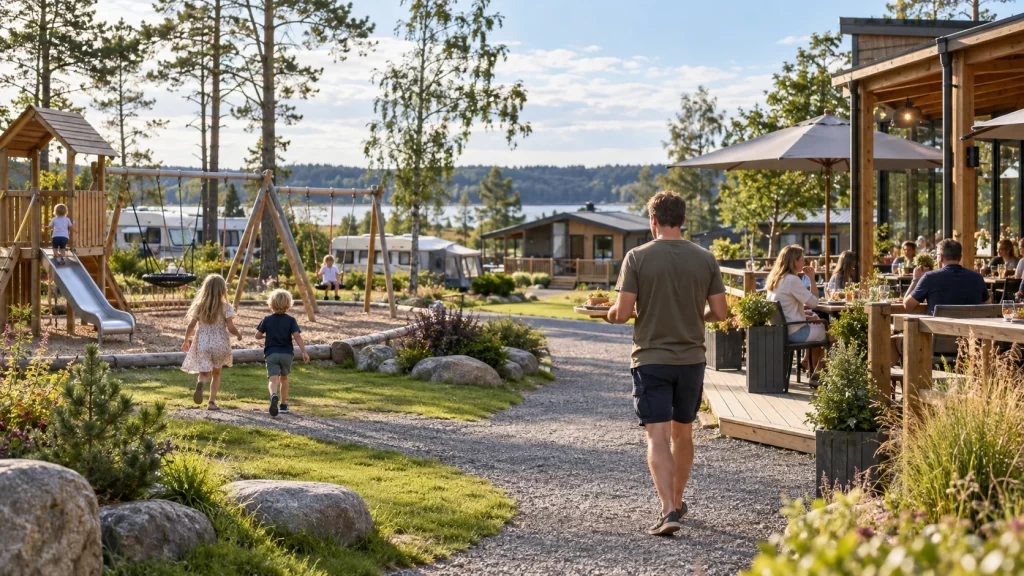
Choosing between playground access and restaurant dining for family convenience depends on which part of the day is hardest to manage. A playground can give children an appealing place to spend their energy near the accommodation. A restaurant can make meals simpler when everyone is tired or the weather changes. For many families, the most useful option is the one that removes a recurring point of friction from their particular trip.
At Hamre Familiecamping, families can consider both: the campsite lists playground activities and a restaurant, and it says food can be enjoyed there or taken back to a cabin or caravan. How much each facility helps will depend on the children’s ages, the family’s routine and when the facilities are available during the visit.
When playground access makes the day easier
A playground is especially useful when a family needs something to do between bigger outings. After a drive or a day away from the campsite, children may still want to move while adults would rather stay close to their accommodation. Nearby play space offers an option that does not require another trip or much preparation.
Hamre Familiecamping describes a playground, a jumping pillow and an interactive play area with features including a football enclosure and a DJ bench. It also lists play and sports areas by the beach. That variety may matter if children have different interests: one might want active games while another prefers familiar playground equipment. Families can also use the play areas during a short visit, according to the campsite’s information.
Convenience still depends on the child and the adult supervising them. A toddler may need close attention even when a playground is nearby. Older children may enjoy a longer play session, but parents should decide what level of supervision fits their family. It is also worth thinking about weather, clothing and how easily children can move between the play area and the place they are staying.
For example, a family returning from an outing in the afternoon might find that a short playground visit gives the children time to play before dinner. That is more helpful if the adults have the energy to supervise and the children are dressed for the conditions. Proximity alone does not turn playtime into a break for everyone.
When restaurant dining saves more effort
Meals can be the difficult part of a family holiday, particularly after a full day out. Restaurant dining reduces the need to plan a menu, prepare food and clean up afterward. It can also help when a family arrives without groceries or decides that cooking would take too much time that evening.
The restaurant at Hamre Familiecamping is presented as a relaxed place to eat. The campsite also says guests can take food back to a cabin or caravan. That choice is useful for families who want the ease of prepared food but would rather eat in their own space. A child who is worn out after an outing, for instance, may be more comfortable eating back at the accommodation than sitting through a restaurant meal.
Restaurant access does not mean every meal needs to be bought. Families staying for several days may prefer to cook some meals, especially if their children have established food routines or they want more control over what and when they eat. The campsite lists cooking facilities, so dining out can be considered alongside self-catering. Before relying on the restaurant for a particular meal, check its current opening times and food options; availability and suitability matter more than simply seeing a restaurant on a facilities list.
Compare the moments that matter most
Rather than choosing the facility that sounds most attractive, picture an ordinary day of the holiday. Where is the family likely to need help? A useful comparison covers a few practical questions:
- Between activities: Will children benefit from a nearby place to play while the family waits for the next outing or meal?
- At mealtimes: Would prepared food remove a stressful task, or is cooking together already an easy part of the routine?
- With different ages: Can the adults comfortably supervise everyone in the play areas, and can everyone manage a restaurant meal?
- In poor weather or during quieter periods: What alternative will the family use if outdoor play is unappealing or a dining option is unavailable?
These questions also help prevent a common planning mistake: treating a listed facility as if it will solve the whole day. A playground may be a welcome addition, but it does not replace rest, suitable clothes or supervision. A restaurant may simplify dinner, but families still need a plan for other meals and snacks.
For more detailed information on this topic, read our guide on How Shared Cooking Facilities Support Flexible Camping Meals.
The benefit of having both within reach
Playground access and restaurant dining serve different needs, so they often work best together. Children can play during an open stretch of the day, while adults keep dinner simple later. Alternatively, a family might spend most of the day elsewhere, collect food on the way back to its cabin and leave playground time for the next morning. The value lies in being able to adapt without building every hour around a fixed plan.
Hamre Familiecamping offers cabin and camping accommodation as well as activities, and it is described as a year-round campsite. That does not establish that every facility operates in the same way throughout the year. Families traveling outside a busy holiday period should confirm the details that will shape their stay, especially restaurant hours and access to the activities they most want to use.
If energetic children and gaps between outings are the main challenge, playground access may do more for daily convenience. If meals are the point where plans regularly become difficult, restaurant dining may have the greater effect. Consider the whole day, including how the family prefers to eat, play and rest. The most convenient choice is the one that fits those habits in practice.